
Clearing the Air: The TOP Three Things IT Teams Get Wrong About Radio Management — And Why It Matters for Your Agency
The radio shop and the IT department are both right — they're probably just talking about completely different things.
If your agency manages a Motorola ASTRO 25 or MOTOTRBO radio system, chances are you've had “the conversation” — the one where the radio shop and the IT department talk past each other. Radio professionals speak in bands, coverage areas, zone controllers, codeplugs, and talkgroups. IT pros speak in VLANs, CIDR blocks, security posture, virtualization and change management. Both groups care deeply about doing their jobs right. But when it comes to considering Radio Management systems, a handful of persistent misconceptions can create friction, delay implementation, and even lead agencies to long term decisions that they will regret.
We work at the intersection of IT and mission critical radio systems every day. The information here is based on decades of experience in ASTRO 25 and TRBO, but also our professional capacity in designing, deploying and operating Radio Management systems and safely and efficiently integrating them with working IT environments. So, read below for three misconceptions often held regarding Radio Management — and what the technical realities actually are.
Misconception 1: "The Radio Management System Is Part of The Radio Network"
This is probably the most common source of confusion, and it's understandable. The Radio Management system manages radios, so it must be embedded in the radio system infrastructure, right?
It isn't.
Radio Management is an entirely independent platform. It has no role in your P25 core network operations — no involvement with Zone Controllers, Repeaters, the UEM, the UNC, or other aspects of the trunked or conventional radio system. Your radio system's private IP network (the Radio Network Infrastructure – RNI) and your Radio Management system are separate and distinct. The only potential point of integration involves Over The Air Programming — OTAP — and that is a deliberate (and very useful) option, not a default dependency.
Why does this matter practically? Because IT departments that believe RM is embedded in the radio network often assume they have no control over it, or think that they’ll need to apply the same security and access restrictions to RM that govern the radio system itself. That creates unnecessary complexity, slows deployments, and generates networking requirements that are unnecessary. Understanding that RM is independent of the radio network and indeed can be part of the customer’s existing, secure IP network changes that conversation entirely.
Misconception 2: "If the Radio Management Server Goes Down, the Radios will Stop Working"
This misconception carries real consequences. When agencies — particularly public safety agencies — believe that Radio Management is operationally critical to call processing, they treat it with a level of risk aversion that can paralyze decision-making around hosting, upgrades, and modernization.
The reality is straightforward: your radios keep working regardless of whether the Radio Management server is reachable or functioning in any way.
Radio Management is a programming and configuration tool. It is how you manage codeplugs, push updates, and maintain your radio fleet. It is not involved in call processing, trunking, or day-to-day radio operations. Think of it as a supercharged evolution of CPS (Customer Programming Software). If the RM server were unreachable tomorrow morning, your officers, technicians, and field personnel would continue communicating normally. The only thing that stops is the ability to push new programming — which is an administrative function, not an operational one.
This distinction matters enormously when evaluating cloud-hosted Radio Management. The risk profile is administrative continuity, not operational resilience. Those are very different conversations.
For MOTOTRBO systems, Radio Management can indeed perform key system configuration functions on the repeaters and the controller(s), but it is still not needed for call processing. In particular, MOTOTRBO Capacity Max trunking systems cannot be configured without Radio Management. However, when you’re not making infrastructure changes or sending a codeplug to a radio via OTAP, the Radio Management system is not needed and could be shut down if desired.
Misconception 3: "Cloud Hosting Means Our Radios Are Exposed to the Internet"
The mental image — police and fire radios exposed to ‘hostile bots and opening the agency’s network to hackers is understandably alarming to any security-conscious IT team. It's also NOT what happens.
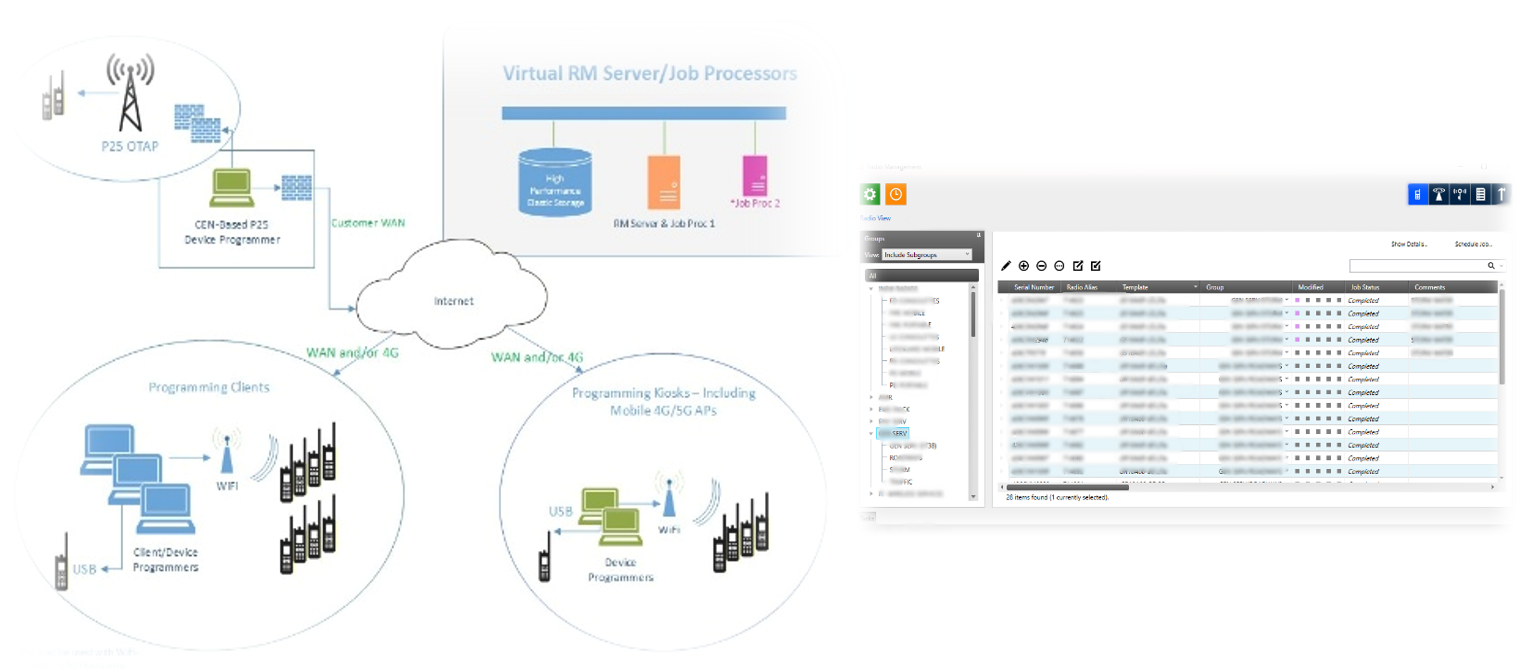
Here is the actual architecture:
APX, N-Series and APX Next radios do NOT talk directly to the Radio Management server, regardless of where the server is located. They instead talk to a Device Programmer on the customer’s own network. A Device Programmer is simply a low-spec physical or virtual Windows PC running Motorola’s Device Programmer service. The Device Programmer is located on your local network. When a Wi-Fi-capable radio comes into range of a pre-provisioned Wi-Fi access point (radios only connect to known networks), it announces its identity after it is assigned an IP on the LAN. The Radio Management Device Programmer servicing that subnet consumes the radio’s announcement and then queries the hosted RM server. The outbound and inbound traffic to the internet uses TLS on port 443 - the same encrypted channel your agency already uses for everyday secure web traffic. The Device Programmer’s query checks for any pending programming jobs on the server for that radio. If a job exists, the Device Programmer executes it locally. The system can have one or a great many Device Programmers. If you are not considering Wi-Fi for the radios or have radios that are not Wi-Fi capable, USB connectivity for programming works in much the same way.
Your radios never touch the internet. They connect only to your local network infrastructure. All internet-bound traffic originates from inside your network, initiated outbound from the Device Programmer PC. The hosted server never initiates an inbound connection to your agency network or the hosted radios.
For IT teams familiar with how modern SaaS applications work, this architecture is immediately recognizable — outbound-initiated, encrypted, with your radio fleet remaining entirely within your network perimeter.
Why This Matters Now
Agencies running on-premises Radio Management are facing a decision point. Server hardware ages. Windows Server versions reach end of support. Internal expertise turns over. The question of whether to 1: refresh on-premises infrastructure, 2: move to a hosted model, or 3: do nothing is one more agencies are confronting every budget cycle.
Making the decisions correctly requires both the radio shop and IT leadership to be working from accurate information — not inherited assumptions about how the system works.
In our next piece, we'll speak directly to agencies currently running on-premises Radio Management and lay out an honest comparison of what continuing on-premises versus moving to a professionally hosted model actually looks like in practice — on cost, on risk, on operational burden, and on support quality and continuity.
One important consideration for agencies already running on-premises RM: your existing database licensing investment doesn't need to be discarded if you move to a hosted model. We'll address that directly in our next piece.
Allenfort & Associates, Inc. provides expert Radio Management hosting, support, training and consulting for ASTRO 25 and MOTOTRBO radio systems. We are trusted consultants for ASTRO 25 and MOTOTRBO system operators throughout North America. We work with government agencies and industrial operators who need deep technical expertise that they may not immediately have at hand.