
Is It Time to Move Your APX Radio Management System to the “Cloud”?
Moving to the cloud doesn't mean starting over....
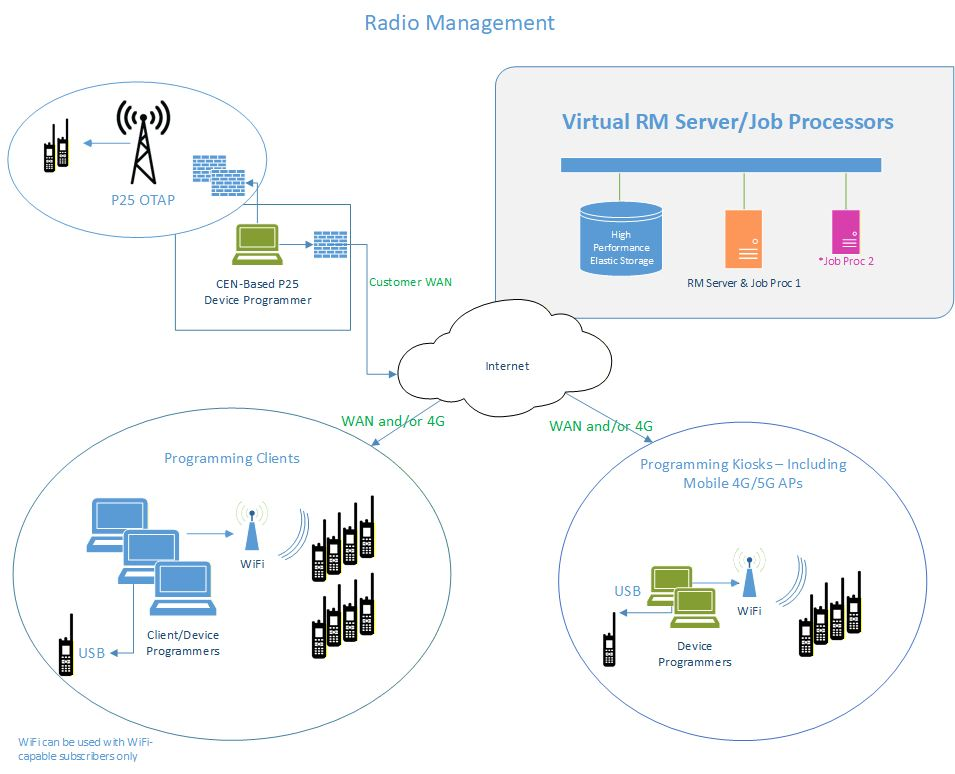
If you are responsible for an on-premises Radio Management system today, you've already made a significant investment. You purchased the database capacity licenses from Motorola. You went through the deployment, the configuration, received training (hopefully) and reaped the benefits of pushing through the learning curve. Whether your system runs on a physical server or a virtual machine, it's running — and it's doing its job.
So why would you consider moving your RM server into “The Cloud”?
In the article below we present our honest take on what staying on-premises actually costs over time — and what a professionally hosted alternative looks like in practice.
You already have one HUGE advantage:
Your current on-premises Radio Management system contains a very valuable investment (besides all of your data): the Radio Management database capacity licenses you have already purchased from Motorola!
For agencies deploying Radio Management for the first time, licensing the database represents a significant upfront capital investment. If you’re already operating your RM system, you've already absorbed those costs. Moving to a professionally hosted platform doesn't require you to repurchase or abandon those licenses — they move with you. The transition to cloud hosting is a change in where and how your system is hosted, managed and supported, not an abandonment of your existing investment.
There's another advantage you retain when moving to the cloud: your radio management data is your data. A professionally hosted Radio Management database is fully portable. If you ever chose to move your RM data to another provider or return to a self-managed on-premises server, your fleet data goes with you.
The Hidden Costs of Staying On-Premises:
The true cost of an on-premises Radio Management system isn't just the initial investment — it's that initial outlay plus perpetual operational and management costs. Some of these costs are visible on a budget line, others aren't, but they're real, nonetheless.
For systems utilizing Physical Servers: Server infrastructure doesn't run indefinitely. When your current hardware approaches end of life — or when the Windows version on which it depends reaches the end of Motorola’s or Microsoft’s support — you're facing a refresh cycle. Sometimes you can simply upgrade the server you have, but often your existing server cannot run the supported Windows version. Costs for new hardware procurement, migration, testing, and potential downtime usually don't appear on a current budget but are coming, nonetheless. Critically, server/OS upgrades are Capital Expenses — they require budget authorization cycles that can be slow, competitive, and unpredictable.
For agencies running RM on a Virtual Machine: The hardware lifecycle concern is largely addressed — that's one of the main advantages of virtualization. But the other operational costs remain, and in some respects the virtualized model introduces its own complexity. RM becomes one more application competing for VM resources, customized snapshot policies, and IT department time and attention alongside every other system in the environment. Radio Management often doesn’t fit with the policies and procedures developed for the other applications in the server farm.
Field connectivity headaches. This factor applies equally to physical servers and on-prem virtualized deployments: Every time a technician needs to program a radio in the field, an on-premises system presents a networking puzzle first. VPN clients, agency network access, connectivity troubleshooting — these are recurring time costs that do not appear in formal accounting of what the system costs to operate. If you’re not often in the field yourself, go ask a radio technician how often field programming has turned into a connectivity troubleshooting session before any actual radio programming gets done. Planning for a field upgrade must seriously consider the agency’s private network availability, VPN access or even offline programming options.
Radio Management application expertise. Is there someone in your organization who deeply understands your Radio Management system — not just the server infrastructure, but the application itself? Codeplug/template management, user administration, Device Programmer admin and configuration, job processor requirements? What happens when a key person retires, transfers, or moves on? This is one of the most underappreciated operational risks agencies face, and it's entirely separate from how well the underlying infrastructure is managed.
IT Departments and Organizational Dynamics:
If your RM system is managed by your IT department — particularly in a virtualized environment — they may not experience this role as a burden at all. In fact, they (or you) may be managing it competently and view it as firmly within their domain.
IT knows how to keep a server running. That’s not really in doubt. What we'd offer instead is a different way to think about where Radio Management expertise actually lives.
Managing the infrastructure that runs RM — the server or VM, the OS, the backup/snapshot policy, the IP network — is an IT function, and IT often handles it very well. But Radio Management as an application is unique and highly specialized. Understanding how to configure it for optimal performance, troubleshoot application-level issues, manage large codeplug push operations, or advise on system design changes requires deep Motorola radio system knowledge that most IT departments don't have — and shouldn't be expected to have either.
Professional third-party hosting doesn't displace IT. Rather, hosting your RM system lets IT focus on core infrastructure, while putting Radio Management application expertise where it belongs — with people who work with radio systems and radio management every day.
One area in which IT excels and must control is the flow of traffic into and out of the enterprise. This is a large part of the network security posture and hosting does not impact this in any negative way. When RM is hosted in the cloud, all of the radio management traffic is outbound-initiated from your network. This means that the IT department maintains complete control over your network security posture. For more details on this aspect, refer to our previous article: The TOP Three Things IT Teams Get Wrong About Radio Management — And Why It Matters for Your Agency
What Professional Cloud Hosting Actually Looks Like:
Government agency customers of Allenfort & Associates are hosted in AWS GovCloud by default. This is the same secure cloud infrastructure used by the Department of Justice, the Department of Homeland Security, and other federal, state, tribal, county and other authorized government agencies. These agencies have the most demanding security and compliance requirements, and the AWS GovCloud meets these requirements. Allenfort & Associates currently hosts a public safety Radio Management database supporting more than 20,000 APX series radios; one of the largest independently hosted deployments of its kind. We have years of experience maintaining and supporting public safety agencies using cloud-based systems.
Here's what a cloud-hosted model delivers:
Immediate field accessibility. Because your hosted server is in the cloud, any Device Programmer on your network reaches it using standard encrypted web protocols. No VPN. No agency private network dependency. If a technician has internet access, they can program radios. The field connectivity problem that can plague on-premises deployments disappears entirely.
Higher-specification infrastructure with continuous backup. Our hosted servers are spec'd above what most agencies could deploy on-premises, with 30 days of continuous snapshots maintained at all times. Recovery from any issue is fast and complete — with a defined and modifiable backup retention window that manufacturer-hosted options typically don't offer. For example, our customers enjoy 30 days of backup images to roll back to as needed.
Expert support — immediately. When you have a Radio Management question or need a User or Device Programmer added to your system, we handle it in minutes, not hours. You won’t end up in a ticket queue. We bring deep, hands-on expertise with ASTRO 25 Radio Systems, Radio Management systems and IP Connectivity — in many cases exceeding what manufacturer support channels can offer at any tier.
Scalability on demand. Need to push hundreds or thousands of codeplug updates? We can very quickly provision additional Job Processors to dramatically accelerate large programming operations. This capability isn't available through manufacturer-hosted options and is impractical to replicate on-premises.
Predictable operating cost — accounted as OpEx. One annual, fleet-size-based fee covers hosting, infrastructure, maintenance, and expert support. No surprise refresh cycles. No capital budget competitions. Operating expenses are easier to plan, easier to approve, and easier to sustain year-over-year than sporadic capital outlays.
Upgrades on your schedule. When Radio Management versions need to be upgraded, we work directly with each customer to perform the upgrade on their own schedule. If you don’t see a need to upgrade, you can stay on your release as long as it’s practical for you. When you’re ready to upgrade, it will happen in the least disruptive manner to your own operations.
Migration is straightforward. The migration process for existing on-premises customers is straightforward — your licenses, your data, and your templates move intact. One item to keep in mind is that re-hosting to the cloud will require a ticket be opened with Motorola technical support. We assist with all the steps and due-diligence to make the process smooth. Most customers are up and running in the cloud with minimal disruption to their operations.
How Does the Cost Compare?
Fleet size, system complexity, and support requirements all factor into pricing proposals. Professional, third-party hosting from Allenfort & Associates, Inc., is a customized, concierge service that is very competitively priced and customers are always surprised (pleasantly!) when they compare us to manufacturer-hosted alternatives.
For agencies already running on-premises, the comparison isn't just against manufacturer hosting — it's against the full forward-looking cost of staying where you are. When you factor in the next server refresh, ongoing IT overhead, support gaps, and productivity losses because of field connectivity issues, the picture often shifts meaningfully. And when those future costs are Capital Expenses competing for budget authorization, the predictability of a single annual Operating Expense looks even more attractive.
A Note for MOTOTRBO Operators:
While this piece is focused on ASTRO 25 Radio Management, we can host MOTOTRBO Radio Management systems as well — including large, complex Capacity Max deployments. The economics, licensing considerations, and hosting architecture for MOTOTRBO are meaningfully different and warrant their own treatment in an upcoming article.
Who We Are:
Allenfort & Associates, Inc. brings decades of hands-on expertise in mission-critical radio systems to every engagement. We provide Radio Management design, deployment support, hosting, concierge technical support, foundational and tailored training, and overall consulting for ASTRO 25 and MOTOTRBO operators throughout North America.
Our client list includes the City of San Diego, Dairyland Power Cooperative, and the California Governor's Office of Emergency Services — organizations that depend on their radio systems every day and need support that matches that standard.
We understand both the radio system side and the IT infrastructure side of operating, maintaining and migrating Radio Management systems. Bridging that gap clearly, practically, and taking the concerns of each group into account is something we do every day.
Ready to Take a Closer Look?
If you're running Radio Management on-premises today and want an honest assessment of what migration to a cloud-hosted environment would look like for your specific agency please reach out using our Linkedin contact page , direct message or email us at: